
Why Resistance halfens in parallel
A resistor offers resistance offers resistance to current. I have used the parallel resistance formula to solve an enormous number of problems in my B.E course on Electronics and Communication. However this question did not strike me back then; If a resistor offers a resistance R then why do 2 resistors in parallel offer lesser resistance? This question did not appeal to us probably because in most courses, resistors are learnt after capacitors and while learning, the teacher says that the two formulas (Resistors in series and capacitors in parallel) are similar and we buy it, and start applying it.

I was sitting in Udupi bus-stand waiting for my bus to Bangalore when this question struck me and it took some time for me to get the answers that night. I first tried approaching the problem in terms of the material used for the resistors, which according to me were both the same so it would not generally matter.

We learn in electronics that a voltage source appears to behave like a tank of water maintained at some potential. The resistors in this case act like a pipe, whose diameter restricts the flow of water from the pipe to the ground. So if 2 pipes are connected in parallel, then each pipe would still continue to offer the same resistance to the flow of water but would convey twice the amount of water to the other end. This realization was the key in understanding how resistors also appear to offer only half the amount of resistance to current in an electrical circuit. This can also be thought of as the cases where the two pipes are replaced by one thicker pipe to offers an equallent reduction in resistance.

In the case of Series circuits, however, the pipe would now be twice as long and the distance the water needs to flow doubles and hence the resistance offered by the effective pipe-chain, is twice as much. Hence resistors in series offer double the resistance.
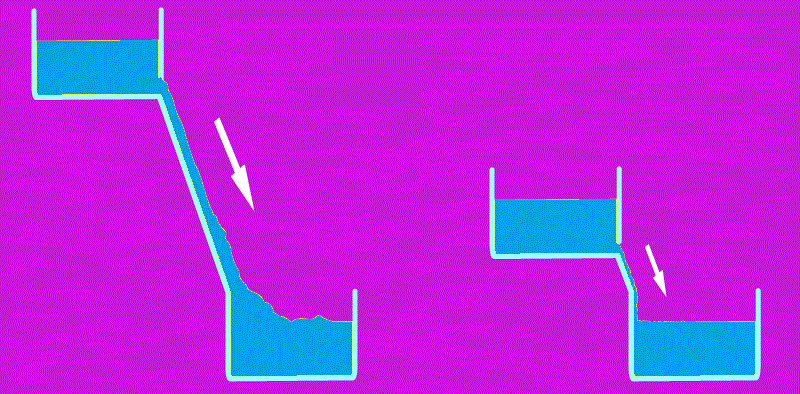
This basic principle can be extended to any number of pipes in series or parallel and hence in resistors as well.

When I discussed this with my friend Ashish in Bangalore, he gave me his own point of view which was that each resistor continued to send the same amount of current across the circuit and hence the doubling of current meant a halfening of resistor value.

We can also look at the problem like a road. If there are parallel roads or one road with several lanes then the traffic can move faster and hence offers less resistance to movement. And if there is just one lane, then the traffic will be clogged and acts as series resistance.

To conclude, the behavior of resistors, pipes, traffic can be analyzed on similar grounds and it is important to know the significance, even though we can manage most situations in life continuing to be ignorant.

Note: We find a similar behavior in all places where networks are involved, such as human body circulatory system, water supply channels, road networks, truss networks, electrical networks, spider web, internet, structure of birds nest, etc. How ever I don't think it is necessary to discuss any of them in detail in this post.

Note: We find a similar behavior in all places where networks are involved, such as human body circulatory system, water supply channels, road networks, truss networks, electrical networks, spider web, internet, structure of birds nest, etc. How ever I don't think it is necessary to discuss any of them in detail in this post.


